Zhao Long Interviewed by South China Morning Post
Zhao Long source:South China Morning Post
New security accord could make western Arctic states warier of working with China and draw Beijing closer to Moscow, Chinese observers say.
The new US-Denmark-Greenland security agreement could narrow China’s room to engage in the Arctic – particularly in resource-rich Greenland – and potentially push Beijing closer to Russia, Chinese experts on the matter said.
According to observers, the deal – signed on Tuesday – could have the broader effect of accelerating the securitisation of the Arctic and making Western Arctic states more cautious about cooperation with China. But it would be unlikely to significantly disrupt China’s existing Arctic cooperation with Russia, which is largely centred far from Greenland.
The deal comes eight months after US President Donald Trump began pressuring Denmark and Greenland – an autonomous Danish territory – over the island’s future, including threats involving tariffs and military force. It expands the US military role on the island while leaving Greenland under Danish control.
The agreement comes at a time when the US and its allies are seeking to build their own rare earth supply chains to counter China’s near-monopoly on the critical minerals, a prime source of leverage that continues to loom over talks between Trump and his Chinese counterpart, Xi Jinping.
Greenland sits atop some of the world’s largest undeveloped mineral deposits, including rare earth elements, as well as iron ore, graphite, tungsten, palladium, vanadium, zinc, gold, uranium and copper.
Under the deal, non-Nato states cannot establish military installations or maintain a persistent military presence in Greenland without mutual agreement. Non-aligned foreign investment in resource extraction and critical infrastructure is also strictly limited.
Zhang Yao, a senior fellow at the Shanghai Centre for RimPac Strategic and International Studies, said the agreement appeared to have China in mind because Beijing was neither a US ally nor a Nato partner.
“The signing of this agreement will bring some negative factors for China’s future Arctic cooperation with Denmark and other Arctic states, particularly in and around Greenland,” Zhang said.
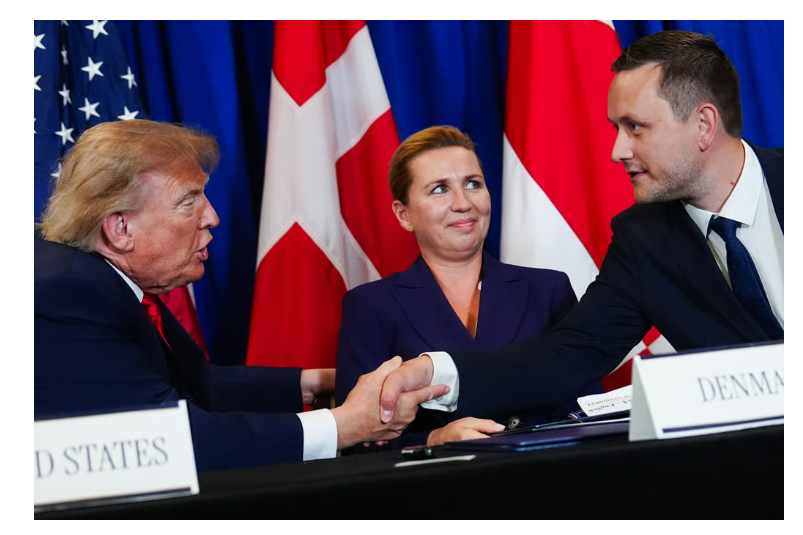
President Donald Trump shakes hands with Greenland’s Prime Minister Jens-Frederik Nielsen as Danish Prime Minister Mette Frederiksen looks on, at a security agreement signing ceremony during the UN General Assembly in New York on September 22. Photo: AP
Danish authorities might become more cautious about economic and infrastructure cooperation with China because they did not want to anger Washington, he added.
But Zhao Long, director and a senior fellow of the Institute for International Strategic and Security Studies at the Shanghai Institutes for International Studies, said the agreement could not be described as a substantial setback to China’s Arctic interests.
“China’s commercial presence in Greenland was already extremely limited,” Zhao said, adding that Chinese companies did not “view the island as a priority” due to commercial and operational constraints.
The country’s 2018 Arctic policy white paper described China as a “near-Arctic state” and an “important stakeholder” in Arctic affairs, outlining interests in scientific research, environmental protection, shipping, resource development and Arctic governance. It also promoted the idea of a “Polar Silk Road”.
Western scrutiny of China’s activities in the Arctic has since intensified.
In 2019, then-US secretary of state Mike Pompeo challenged China’s description of itself as a “near-Arctic state”. In 2020, Ottawa blocked Shandong Gold Mining’s proposed acquisition of the Hope Bay gold mine in Nunavut, the remote territory in northern Canada that encompasses most of the Canadian Arctic.
However, Zhang stressed that China’s Arctic interests were primarily focused on “low politics” areas such as trade, shipping, scientific research, environmental cooperation and exchanges with indigenous communities.
“There are no military or geopolitical conflicts with Arctic states in these areas,” he said.
Zhao argued that the more significant long-term effect could therefore be indirect: the agreement could further embed the Arctic in Nato’s security framework and make other Arctic states more cautious about working with China.
Such a shift could affect Chinese participation in scientific research and Arctic governance, potentially adding to the fragmentation of Arctic cooperation, he added.
That security shift also has implications for Russia, the dominant Arctic power and China’s most significant partner in the region.
The atmosphere for international cooperation in the Arctic had deteriorated since Russia’s invasion of Ukraine, Zhang said.
Finland and Sweden’s accession to Nato has left Russia as the sole non-Nato member among the eight Arctic Council states, while Western sanctions and corporate withdrawals have disrupted cooperation with Moscow in areas including energy.
The Greenland agreement was unlikely to have a major immediate impact on China-Russia Arctic cooperation, experts said.
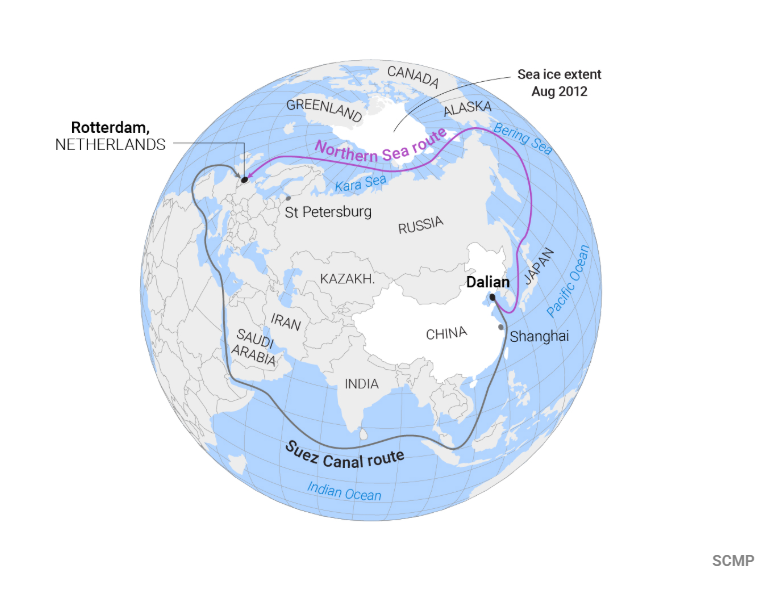
Liu argued that stronger US and Nato security involvement in the Arctic could, however, push China and Russia towards closer cooperation as competition over the region’s resources and shipping routes intensifies.
Zhao, however, cautioned against drawing a direct link between the Greenland agreement and closer China-Russia cooperation.
“Beijing’s Arctic drive with Moscow stems more from strategic and economic needs than from external pressure,” he said.