Zhao Long Interviewed by South China Morning Post
Zhao Long source:South China Morning Post
Since Chinese container ships began regular services on the Northern Sea Route three years ago, the Arctic shipping lane has gained global importance. Houthi attacks on commercial vessels in the Red Sea later in 2023 disrupted traffic through the Suez Canal - the fastest route between Europe and Asia - in what was the most serious conflict-driven disruption since the Arab-Israeli war nearly six decades earlier.
As conflicts around the world highlight the vulnerability of global shipping lanes, China and Russia are reportedly weighing the possibility of turning a vast river into an inland cargo route to the rest of the world.
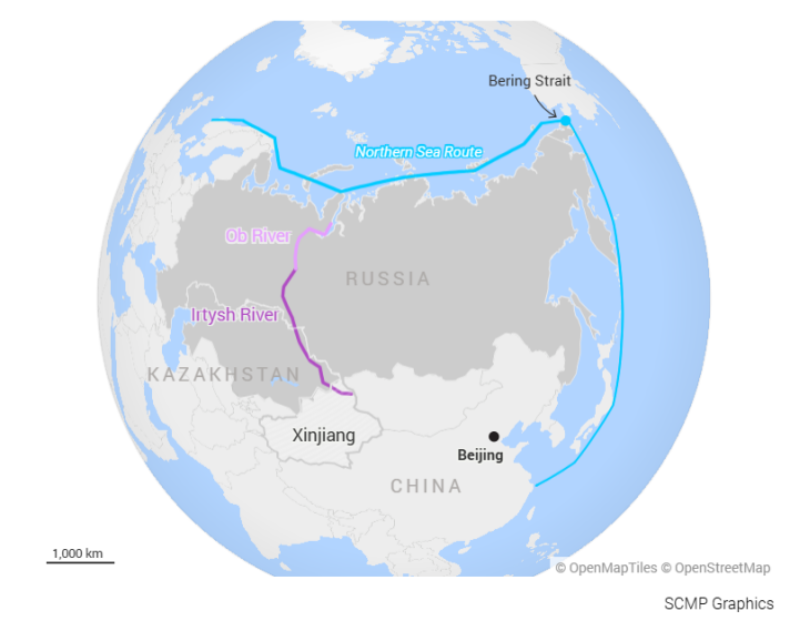
At the heart of this ambition is the 4,248km (2,640-mile) Irtysh River, which originates in China’s western Xinjiang Uygur autonomous region and runs through Kazakhstan before flowing into Russia’s Ob River and ending in the Arctic Ocean.
To China, this river-to-sea shipping route could offer inland access to the resource-rich and strategically important Arctic.
More importantly, unlike traditional maritime chokepoints like the Malacca and Bering straits, the route could avoid Western naval blockades, foreign coastguard surveillance and sanctions by the United States, according to observers.
From the Irtysh to the Arctic
Shipping through the Arctic – the so-called Northern Sea Route – was long impractical due to the thick ice that covered the sea for much of the year. But warming temperatures have gradually made the passage more viable, raising China’s interest in the route.
That interest has been compounded by geopolitical tensions.
Zhao Long a senior research fellow at the Shanghai Institutes for International Studies, said Russia’s invasion of Ukraine and the crisis in the Strait of Hormuz were raising prospects for alternative shipping routes.
“Both overland transport corridors and maritime shipping lines are facing the impacts of geopolitical conflict and the spillover effects of these conflicts are increasingly long-term and pronounced,” Zhao said.
“Therefore, any potential solution that offers additional route options will inevitably gain momentum.”
An added advantage is the amount of time saved. Voyages along the Northern Sea Route could go from China’s Ningbo port to Felixstowe in Britain in 20 days, compared to 40 days via the Suez Canal.
Chinese freight companies are already seeing the potential. Earlier this month, Chinese carrier Sea Legend Line launched a regular weekly container service along the route, the first of its kind using the Arctic Ocean.
Alexei Likhachev, head of Russia’s state atomic energy corporation Rosatom, which manages the Northern Sea Route, said that more than 30 shipments were expected along the route this year. That is up from 14 in 2024 and 24 in 2025, according to news agency Interfax.
Likhachev said shipments between Chinese and Russian ports accounted for nearly 15 per cent of all cargo traffic along the route, adding that freight between the two neighbours via the Arctic Ocean “should reach 20 million tonnes by 2030”.
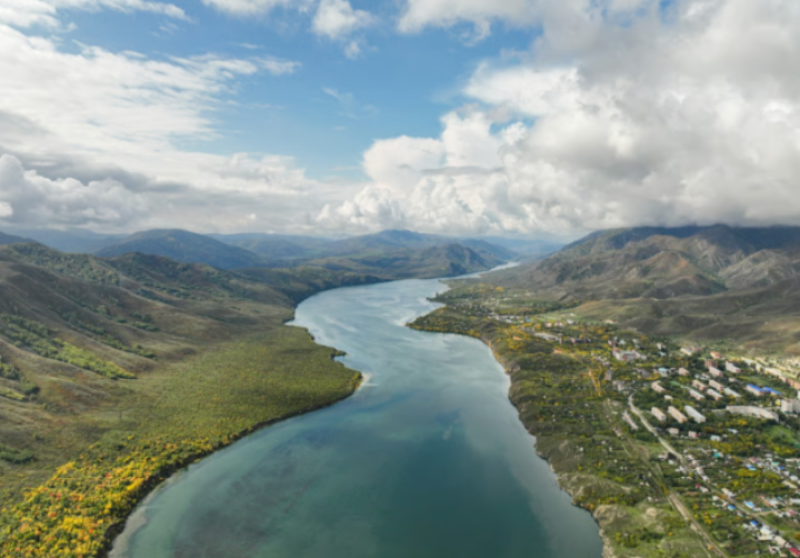
The Irtysh River winds through a valley with the city of Serebryansk in Kazakhstan nestled on its banks. Photo: Shutterstock
But China’s access to the route now relies on the Bering Strait, making it a potential chokepoint for Beijing – and Moscow – in the event of an American blockade launched from Alaska.
Separating Russia’s Chukchi Peninsula from the Seward Peninsula of Alaska, the Bering Strait is the only marine gateway between the Arctic and Pacific oceans. At its narrowest point, the strait is only about 85km wide.
During the Cold War, both the US and Soviet Union fortified their sides of the strait, which was often transited by submarines collecting intelligence.
Marc Lanteigne, a professor with The Arctic University of Norway, said the militarisation of the Arctic had been revived in recent years and that the US was now monitoring Alaskan waters more closely.
Since 2015, Chinese and Russian navies have carried out regular patrols in the Bering Strait. In July 2024, for the first time, Chinese and Russian strategic bombers flew over the area, prompting the North American Aerospace Defence Command to scramble US F-16 and F-35 fighters alongside Canadian CF-18s to intercept the formation.
In October 2024, the China Coast Guard entered the Arctic Ocean through the strait in a joint drill with their Russian counterparts for the first time, an operation that Chinese observers said at that time had effectively expanded the coastguard’s far-seas operational range.
This activity has raised alarm in the US
In July last year, US President Donald Trump signed a budget bill with almost US$25 billion in extra coastguard spending, including almost US$9 billion for new icebreakers and US$300 million for new facilities in Alaska.
When the Chinese research icebreakers Xuelong and Xuelong 2 passed north through the US exclusive economic zone and over the extended North American continental shelf in the Bering Sea last month, they were watched closely by both Canadian and the US coastguards for days.
This proximity to the US “is why the Northern Sea Route passing through the Bering Strait is never safe geopolitically”, according to Artyom Lukin, a professor of international relations at Far Eastern Federal University in Vladivostok.
“If China wants an assured access to the Arctic Ocean, it needs to solve the Bering Strait dilemma. A corridor along the Irtysh River, via China itself, Kazakhstan and Russia, is one obvious solution.”
Zhao said that while passing through the Bering Strait remained the most economical option, developing the Irtysh River made sense for contingencies.
“If extreme situations arise – such as a total blockage of the strait making it unnavigable, whether due to natural causes, political reasons or security factors – then obviously, you still have a backup plan.”
While landlocked Kazakhstan has long sought to develop the Ob-Irtysh system, the vision gained momentum in 2024 when the country revealed a concrete plan to develop the route.
Then last year Kazakhstan approved a blueprint to develop shipping on the river system.
Speaking last month at a Russia-Kazakhstan cooperation forum held beside the Irtysh in the city of Omsk, Russian President Vladimir Putin said Moscow and Astana were working together on plans for the river and aiming “to strike a balanced approach between increasing freight transport, developing water resources and preserving the river’s ecosystem”.
Batyrbek Musin, an adviser to the board for development at Pavlodar River Port on the Irtysh, said the three nations were actively considering the new transport corridor.
“This strategic issue can take the form of a ‘Water Silk Road’,” Musin said on the sidelines of the forum, according to news portal Russia’s Pivot to Asia.
The Chinese government has not made any statement on the proposed route.
Kazakhstan hopes to expand its shipbuilding, repair and port facilities to support heavy freight on the Irtysh. The goal is to increase its annual cargo traffic to an estimated 2.5 million tonnes, from the 1.5 million tonnes today.
Russia, meanwhile, has designated the Ob-Irtysh system as part of its planned Trans-Arctic Transport Corridor, a broader strategic project aimed at creating shipping routes beyond the reach of Western sanctions.
Zhao, in Shanghai, said this project could link Russia’s vast Siberian heartland with the Chinese market.
“This aligns with Russia’s need to reduce its transport dependence on Europe under Western sanctions, while also fitting into its broader foreign policy pivot.”
But turning the river into a major trade artery will not be easy.
Navigating the river system would mean overcoming the harsh Siberian winters that freeze the waterway for up to six months a year, possibly limiting commercial shipping to a narrow summer window.
Meanwhile, seasonal low water levels and heavy silting also create shifting sandbars, which would require huge dredging capacity so that large cargo barges would not run aground.
As part of its cooperation with Russia, Kazakhstan launched its first dredger, the Irtysh-2503, in April.
In addition, getting cargo to and from China’s densely populated coast to remote Xinjiang – especially in the quantities required to make the river route worthwhile – would require further infrastructure investment.
Lanteigne said that in expanding infrastructure along the Irtysh River, authorities would also need to balance preserving the waterway as a source of fresh water.
Another key challenge for the project would be navigating China and Russia’s subtle tug of war for influence in Central Asia.
“Astana has been seeking to diversify its regional friends, including China as well as in the Caspian region, while Russia has been trying to maintain its traditional role as a security guarantor in Central Asia.”
Lukin said that making the Irtysh route navigable would require enormous investment and the renewed political support of the three countries.
“The total costs could be in the tens, and even hundreds, of billions of dollars. Only China has the resources on such a scale.
“But will it commit such huge investments to the project that mostly runs through the territories of Russia and Kazakhstan? Undertaking the Irtysh project requires a whole new level of trust and closeness between China, Russia and Kazakhstan.”