Zhao Long Interviewed by Newsweek
Zhao Long source:Newsweek
China is paying Russia hundreds of thousands of dollars to join its scientific expeditions to the Arctic, as it seeks to expand its footprint in the icy region at the center of a geopolitical security contest highlighted by President Donald Trump.
China’s presence on the Russian ships was disclosed to Newsweek by Chinese researchers and officials who gathered at a research conference in the Arctic Circle in early February. Newsweek was one of the only Western media outlets present at the Chinese event in Norway.
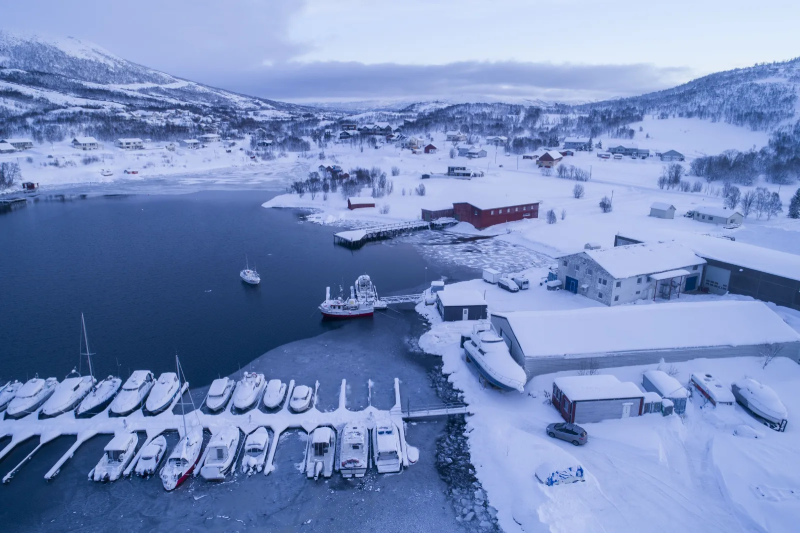
Kaldfjord harbour near Tromsø, northern Norway, pictured on January 19, 2019. | OLIVIER MORIN/AFP via Getty Images
One Chinese researcher who works at a state institute told Newsweek that Russia had conceded to allowing Chinese teams on the trips because its wartime industry needed funds. “Russia is very territorial” about its long Arctic coast and has denied China permission to build research stations there, but “they need money because of the war in Ukraine,” said the researcher, who spoke on condition of anonymity due to political sensitivities.
“We go with them and we bring back samples,” the researcher said, referring to natural materials such as water, rocks and sediment. They declined to specify the cost but said it was less than one million Chinese yuan ($120,000) per trip. There have been four joint Arctic expeditions since 2016, Chinese sources said, with the pace expected to pick up.
China-Russia Collaboration
Russia carefully guards its Arctic coastline, half the world’s total, but the disclosures confirmed another step in China’s quest to gain access to the polar region as part of its multiyear effort to build a “Silk Road on Ice.”
Last July, a Chinese diplomat based in the Russian city of Vladivostok, near the Chinese border, told state news agency Xinhua that a joint Russia-China scientific expedition had sailed to the Bering Sea, on the edge of the Arctic between Russia and Alaska.
The voyage on the scientific vessel Akademik M.A. Lavrentyev was the first joint trip since the COVID-19 pandemic, Xinhua cited a Russian official as saying.
Russia and China have signed multiple scientific agreements in recent years which include high-level information exchanges. In 2019 the two countries set up a joint Arctic research group centered in Murmansk and they have many academic collaborations.
It had not been known previously that China was getting access to the High North through Russian ships.
A spokesperson for the Information and Public Affairs Section of the Chinese Embassy in Washington, D.C., told Newsweek: “China always advocates handling state-to-state relations in accordance with the purposes and principles of the U.N. Charter. The Arctic bears on the common interests of the international community. China’s activities in the Arctic are aimed at promoting the peace, stability and sustainable development of the region. They are in line with the international law. Countries’ right and freedom to carry out activities in the Arctic in accordance with the law needs to be fully respected.” Russia’s Ministry of Foreign Affairs did not respond to a Newsweek request for comment.
But experts say they’re not surprised about China’s trips on Russian ships. Marc Lanteigne, a politics professor at UiT The Arctic University of Norway in Tromsø, said unofficial reports had been circulating for some time of such cooperation but both countries were tight-lipped.
“One of the reasons I’m not surprised by this is China needs things,” Lanteigne said, specifying mapping. “They need as much cartographic data on the Arctic as they can for their emerging Arctic strategy.”
Still, questions remain over the extent of information shared—and whether Chinese scientists were allowed in the waters off Arctic Siberia.
China insists its scientific research is for peaceful purposes, and that it is a constructive player in the Arctic that seeks to promote sustainable development.
But in its 2025 white paper on state security, China added the polar regions to its definition of state security, one of 20 categories that also include the deep oceans and space, as well as territorial and political security.
The Chinese government operates a policy of “military-civil fusion” in scientific research, meaning that all research can be for potential dual use or have both civilian and military applications, long fueling concerns from Western countries. Newsweek has also previously reported that a Chinese institute in the Svalbard archipelago in the Norwegian Arctic was carrying out dual-use research including in the areas of radar and missile tracking, under a name that masked its role in China’s military industry.
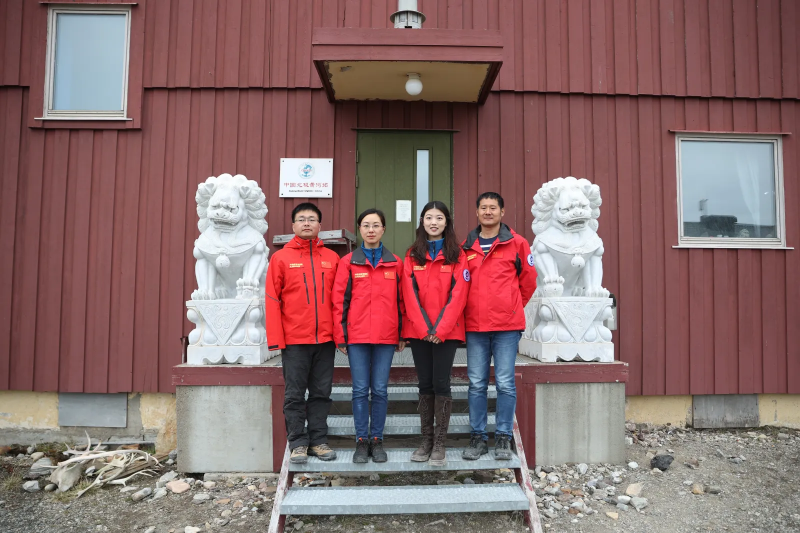
A Chinese Arctic expedition team pictured at China's Yellow River scientific research station in Ny-Alesund, Svalbard, in Norway, on June 23, 2024. | Zhao Dingzhe/Xinhua/Getty
The U.S. has pressured the Norwegian government to clamp down on such activities, with a congressional committee in 2024 writing to Oslo to express concerns.
China has engaged with Russia, but also spent years cultivating relationships with Nordic countries through an organization set up in Shanghai in 2013, the China-Nordic Arctic Research Center.
The researcher Newsweek spoke to made the comments on the sidelines of CNARC’s annual meeting this year, the 11th China-Nordic Arctic Cooperation Symposium held in Tromsø titled “Human Footprints in the Arctic—Remote and On-site.”
China’s Foothold in the Arctic
Since 2018, China has claimed to be a “near-Arctic state,” aiming to become a polar great power despite being geographically distant from the Arctic, unlike Russia, the U.S. and some European nations which have Arctic territories.
Arctic research has boomed in China in the past decade-and-a-half as the country raced to establish itself as a polar force: setting up research institutes in universities and gaining observer status at the Arctic Council in 2013 alongside other non-Arctic states such as Japan and South Korea.
CNARC is made up of 10 Chinese and nine Nordic institutional members with a secretariat at the state Polar Research Institute of China. It meets annually in either China or a Nordic country. Last year’s meeting was in Shanghai, with next year’s scheduled for Wuhan.
Facing growing hostility from the U.S. about its presence at the poles, China has doubled down on relations with Nordic nations to maintain access. CNARC has become a dominant platform for advancing those interests.
The event held from February 1-2 on Norway’s windswept northern coast showed that.
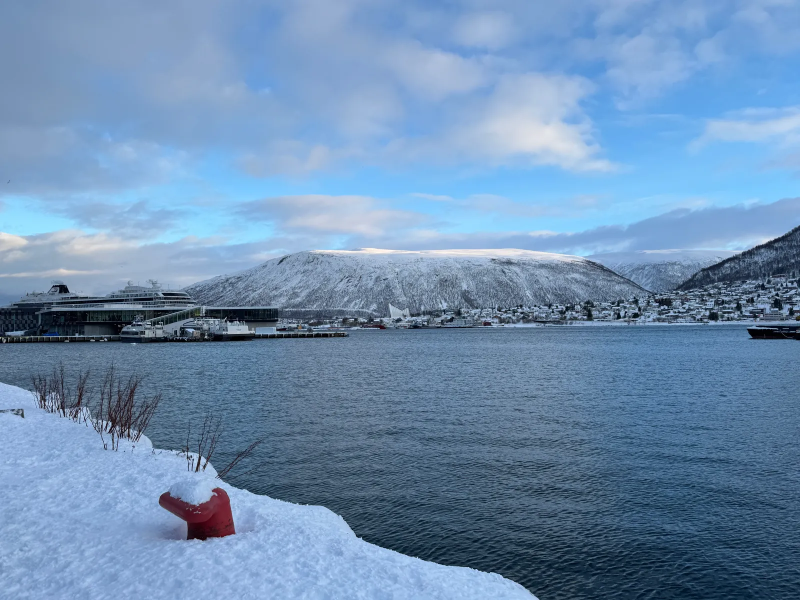
Tromsø harbor in the Norwegian Arctic city where a Chinese-Nordic cooperation platform, CNARC, met on February 1 and 2, 2026. | Didi Kirsten Tatlow
“I think this platform of dialogue has already become one of the major platforms between China and Nordic countries…to address those emerging issues related to Arctic cooperation and governance,” Zhao Long, Russia expert at the Shanghai Institutes for International Studies, where he specializes in global governance and polar affairs, told Newsweek at the meeting.
China has been a “priority country” for research collaboration in Norway, Camilla Brekke, the director of the Norwegian Polar Institute, a state agency, told the CNARC meeting. The topics discussed included scientific cooperation, climate change and melting sea ice. They also focused on developing an Arctic shipping industry where China is a leader. Chinese companies NewNew Shipping and Sea Legend have vessels traversing the Arctic sea route.
As well as a research station in Norway’s Svalbard archipelago, China has a joint one with Iceland in northern Iceland. It has long worked with Nordic radar scientists at a cutting-edge radar installation in the region, subsequently building its own version in China. Other joint research is widespread—if more carefully monitored than before.
The organization had been “essential” for China’s Arctic activities, Zhao of SIIS told the meeting.
“We have to study the European Arctic too, for circumpolar navigation,” said Feng Han, a researcher at the First Institute of Oceanography, part of China’s Ministry of Natural Resources.
Increased U.S. Pressure
Yet like water underneath ice, there was an underlying sense at the meeting in Tromsø that growing geopolitical pressures—specifically U.S. opposition to China’s ambitions in the region—was making the regular forum harder to maintain. Those pressures skyrocketed after Trump demanded the U.S. take greater control of Greenland for U.S. security interests against Russia and China.
However, threatening military action to take territory from a NATO ally played badly with Nordic states like Norway. Washington has also applied pressure on NATO allies to distance themselves from China politically and technologically.
Chinese leaders—and Nordic speakers—at the conference frequently named the U.S. as the source of rising tensions.
“International cooperation is under pressure,” Zhang Beichen of the Polar Research Institute of China told the gathering of 60 scholars and officials. “It is hard to discuss China-Nordic cooperation under new circumstances,” Zhang said. But discuss they did, with the aim of “sustaining China-Nordic cooperation in a shifting era,” said Brekke, the director of the Norwegian Polar Institute.
Analysts say Beijing stands to benefit from Washington’s aggression in the Arctic, where Trump dismissed European allies’ entreaties on Arctic security before eventually agreeing to a deal.
“U.S. Arctic policy is now so mercurial, and with the diplomatic fallout from this whole Greenland situation, that has allowed China to present itself as the responsible Arctic partner,” said Lanteigne.
Anne-Marie Brady, a China politics professor at the University of Canterbury in New Zealand, said China had used CNARC to build bridges, set up relationships with individuals and normalize its presence in the Arctic.
“CNARC was set up in a more innocent age and China wooed the Nordic states through this agency,” she said. “It might be viewed differently now as people gain more knowledge about the importance of the Arctic to China’s security considerations. If it had been Russia they would have been more suspicious, but the Nordic states have been naive and thought they could shape China’s Arctic policies,” she said.
Supporters in Nordic Nations
Speaking in Tromsø at an Arctic Frontiers conference, which followed the two-day China-Nordic event, Norway’s Prime Minister Jonas Gahr Støre pushed back on a question from a reporter suggesting that Nordic officials were not adequately aware of China’s activities in the High North.
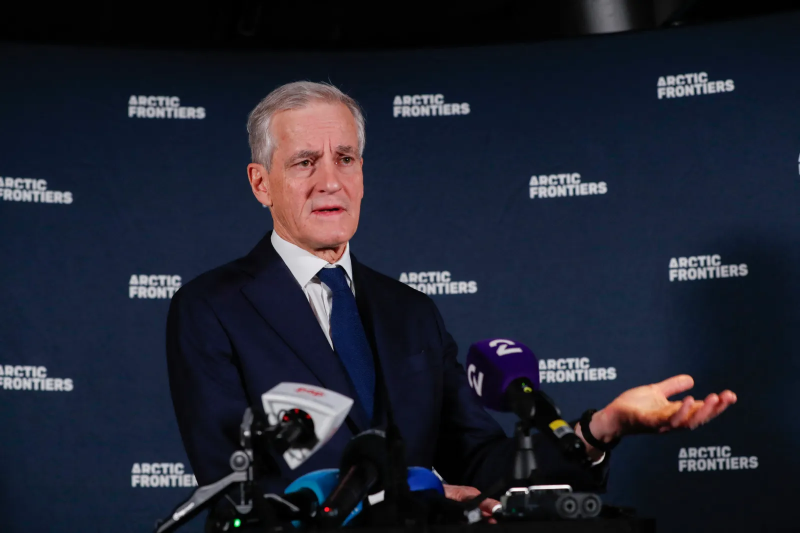
Norway's Prime Minister Jonas Gahr Støre speaks during a press conference at the annual Arctic Frontiers conference on February 4, 2026, in Tromsø, No...Read More | Rune Stoltz Bertinussen/NTB/AFP/Getty
The Norwegian government monitored China’s activities closely, he said. “We have taken a much firmer advice to our research and educational institutions to watch out here because we have seen in the past that there [has] been really dual use, and there has been misuse of research contact with research institutions,” Støre said.
“China with its role, its technological development, its economic development, is a main factor and it is not our policy to say that we lock them out. But we follow them much more closely,” he said.
He added that he could understand “why countries on the other side of the globe take an interest in the Arctic as the climate is changing, as new transport routes open up.”
And Rasmus Gjedssø Bertelsen, a professor at the Arctic University of Norway, said at the meeting he had always been “very, very much in favor of CNARC.”
“I cannot see why we should not relate to one of the world’s two largest economies and one of the world’s two largest technology systems,” Bertelsen said, adding: “I think that the Nordic countries’ reach are small. China is enormous. I think it’s much preferable for the Nordics to meet China in a multilateral setting. For China it’s much more efficient to talk to the Nordic countries together than individually.”