Shao Yuqun Interviewed by South China Morning Post
Shao Yuqun source:South China Morning Post
Washington and Beiing said to be working to secure visit by US president, who might stop in China around the Apecsummit, sources say
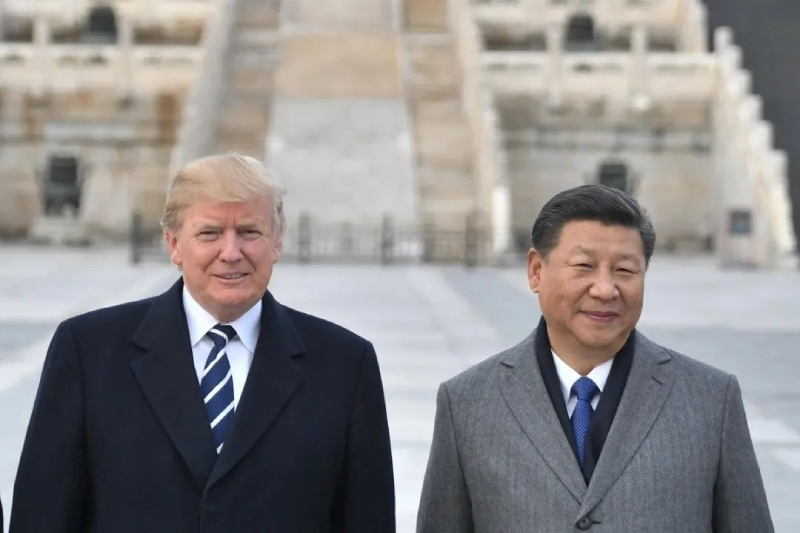
US President Donald Trump and Chinese President Xi Jinping at the Forbidden Cityin Beijing during Trump’s
US President Donald Trump is keen to visit China but a September visit is not happening, according to sources,who said Beijingand Washington were working to secure a trip in October or November.
Hurdles remain, but high-level officials "share a consensus", sources familiar with the matter told the South China Morning Post.
Media reports earlier said that China planned to invite Trump to the Victory Parade in Beiing on September 3 to commemorate the 80th anniversary of the end of World War II.
With September now off the table, Trump might visit China before heading to the Asia-Pacific Economic Cooperation (Apec)summit in South Korea, or he could meet Xi Jinping on the sidelines of the event between October 30 and November 1, according to sources.
Sources also described the Kuala Lumpur meeting between Chinese Foreign Minister Wang Yi and his Us counterpart Marco Rubio earlier this month as "better than expected", It was the first in-person engagement between the respective top diplomats - an essential step before any leader-level summit can occur - and both sides praised the meeting as "positive".
Another person familiar with the discussions said there was a possibility of a meeting later this year, with two options under consideration: Trump could either visit China for bilateral talks before heading to the Apec summit, or attend Apec first and then travel to Beijing.
While no final decisions have been made, the source noted that the time frame surrounding the Apec gathering was being viewed as a potential window for the meeting.
Trump is expected to be in Asia during that period for the Quadrilateral Security Dialogue summit in India, which further aligns with the possibility of other regional engagements.
However, sources added that there would be "no fundamental change" regarding Rubio.
Beijing sanctioned Rubio -- then a senator representing Florida - twice in 2020, making him the first sitting secretary of state to face such measures.
Observers noted that while the sanctions remained in place, China might adopt a more flexible approach -- potentially even allowing Rubio to enter China - to facilitate future talks if relations between the two superpowers improved.
Wu Xinbo,dean of the institute of International Studies at Fudan University in Shanghai, said Beijing could "turn the page on this matter" if Rubio played a positive and constructive role in improving China-US relations.
"There are many things for China and the Us to focus on next,including creating the right conditions and atmosphere for Trump's visit to China" Wu said,adding that the two countries could make progress in various areas including trade, diplomacy,security and law-enforcement cooperation.
"As for the sanctions, they are merely a technical issue, a minor matter -- far less significant than the broader cooperation I just outlined" Wu said.
China first sanctioned Rubio in retaliation for US sanctions on senior Chinese officials over alleged human rights abuses inXinjiang Uygur autonomous region - allegations Beijing denies. He was sanctioned again after Washington penalised mainland China and Hong Kong officials following the 2019 Hong Kong protests.
Shao Yuqun,a senior research fellow in American studies at the Shanghai Institutes for International Studies,said Wang and Rubio's meeting in Kuala Lumpur showed that the 2020 sanctions "have not affected the current technical-level interactions between the two nations' top diplomats".
The sit-down talks took place on the sidelines of an Association of Southeast Asian Nations (Asean) meeting on July 11, where the two countries agreed to strengthen dialogue "at all levels" and deepen cooperation, according to a statement from the Chinese foreign ministry.
"China's approach to handling the sanctions issue is both principled and pragmatic, with the fundamental goal of stabilising the development of the US-China relations," Shao added.
Beijing did not disclose specifics about Rubio's restrictions in either of its 2020 sanctions announcements, Although this ambiguity is not necessarily intentional, it does leave room for interpretation, according to analysts.
In a separate sanctions announcement issued by the Chinese foreign ministry in 2021, Beijing outlined specific restrictive measures. A total of 28 US officials - including former secretary of state Mike Pompeo - and their family members were barred from entering mainland China, Hong Kong and Macau.
The 2021 statement said these people, along with the organisations and businesses affiliated with them, were also prohibited from conducting transactions or commercial activities with China.
Zhu Feng, dean of the school of international studies at Nanjing University, noted that lifting the sanctions was not necessarily the only way for Rubio to visit China.
"The sanctions target his past role as an anti-China legislator, but in his current position as America's top diplomat, he could very well come - as long as China doesn't invoke relevant asset-related legal measures against him,"Zhu said.
He added that Rubio's rhetoric on China-related issues had become more cautious and measured since taking office, a significant shift from his previously hardline stance.
There is no precedent for sanctioned Us and European diplomats to conduct negotiations in mainland China, Hong Kong andMacau, according to Shi Yinhong, an international relations professor at Beijing's Renmin University.
However, it is possible for China to lift previously imposed sanctions, Earlier this month,Beijing removed "restrictions" on Reinhard Buetikofer, the former EU lawmaker it sanctioned in 2021, after rounds of discussions with the European Parliament.
In April, Beijing lifted sanctions on members of the European Parliament and their families as it sought to normalise ties and revive progress on a bilateral investment agreement.
"While China could easily lift sanctions on Rubio, securing his agreement to reciprocal measures would prove far more challenging," Shi said.
He added that Rubio's growing influence within Trump's inner circle, coupled with China's current difficulties, had emboldened the top US diplomat's bargaining position.
"A third-party mediated meeting might serve as a workable interim solution [for the two to meet and talk further] - but only if Rubio consents."