Zhao Long Interviewed by South China Morning Post
Zhao Long source:South China Morning Post
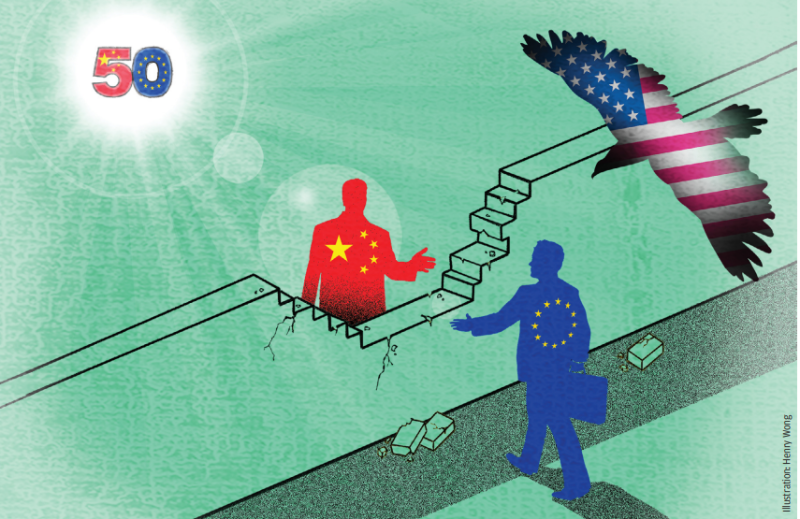
Beijing and Brussels are marking 50 years of diplomatic relations but one third party is putting a damper on the festivities
China has ramped up efforts to mend ties with the European Union ahead of a summit with bloc leaders tomorrow, seeking to capitalise on transatlantic disaffection to promot e cooperation with the EU and counter Washingt on ’ s unilateralism.
But while Beijing’s conciliatory overtures to Brussels are distinct from its adversarial stance towards Washington, a longawaited reset in China-EU ties remains largely out of reach.
Brussels has taken a cautious “de-risking” approach towards Beijing, shaped by its complex alignment with Washington and persistent concerns over China’s global rise. Potential progress is also constrained by structural mistrust, diverging global priorities and Beijing’s strategic tilt towards Moscow amid Russia’s invasion of Ukraine.
In the absence of substantive shifts in strategic posture from either side, observers warn of mi s s ed opportuniti e s to recalibrate the partnership for this year’s landmark 50th anniversary of China -EU diploma ti c relations.
Hopes were initially high for this year’s China-EU summit, set for tomorrow in Beijing, particularly as trade and geopolitical tensions forced the event’s cancellation last year.
As the US-China feud intensified after Donald Trump’s return to the White House, China placed greater emphasis on Europe, highlighting the EU’s role in a broader strategy to counterbalance the United States, according to Feng Zhongping, director of the Institute of European Studies at the Chinese Academy of Social Sciences.
“After Trump took office in January this year, many saw a strategic opportunity for closer China-EU ties, with China anticipating stronger collaboration amid global instability and Trump’s unpredictability,” he said.
And the coming summit seemed the moment to realise that goal, given its timing in an anniversary year and the strains on transatlantic relations.
As part of a coordinated effort to court Brussels, Beijing lifted its 2021 sanctions on several European Parliament members and dispatched top diplomat Wang Yi to visit Paris, Berlin and Brussels this month.
In contrast to its use of rare earth dominance over Washington in its trade war with the US, Beijing also proposed a fast-track channel to facilitate exports of the critical minerals to European companies, drawing comparisons to China ’ s pandemic-era medical supply corridors.
“Rare earth exports have never been, and should never be, an issue between China and the EU,” Wang said, framing the initiative as part of a commitment to cooperation over confrontation.
Throughout his week-long tour, the foreign minister positioned China as a responsible global power and reliable alternative to Trump’s tariffs and his scepticism about Nato.
Wang urged Brussels to maintain strategic autonomy, a diplomatic euphemism for distancing itself from Washington, while taking jabs at the Trump administration and China critics across Europe. “China is different from the United States, so the path the US has taken should not be projected onto China … Today’s Europe faces various challenges, but these challenges have not come from China in the past, present, or future,” he told top EU diplomat Kaja Kallas on July 2, dismissing concerns about Beijing’s growing assertiveness.
However, China-EU relations have not warmed as expected, with Feng highlighting misaligned expectations. “I believe the problem lies in Europe’s strategic misjudgments,” he said, adding that the EU had overestimated its leverage amid the US-China rivalry and made excessive demands based on flawed assessments.
Since 2019, Brussels has seen China as a partner and a systemic rival, while Beijing has framed the EU as a “comprehensive strategic partner”, a difference Feng said significantly deviated from Beijing’s expectations and added to tensions with the bloc.
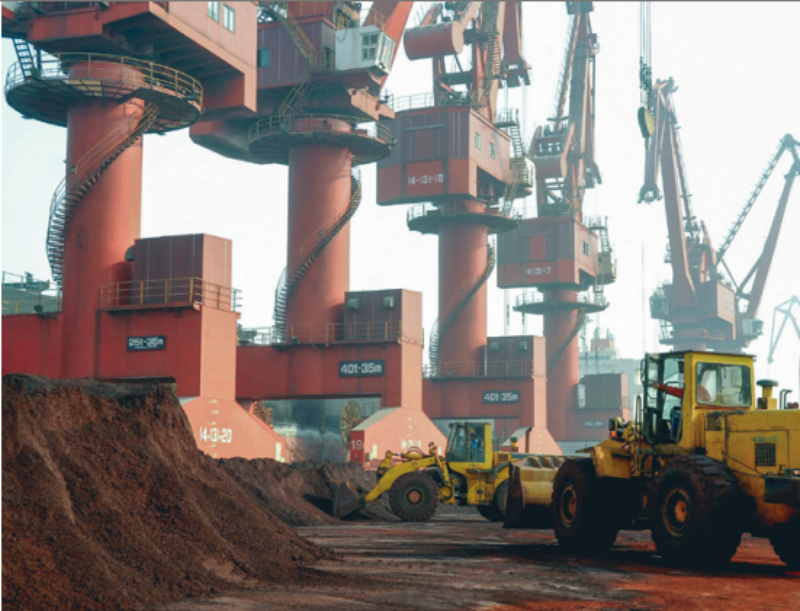
Workers transport soil containing rare earth elements for export at a port in Lianyungang, Jiangsu province. Photo: Handout
The focus now was on making sure conditions did not worsen, he added. “The smooth conven-ing of the China-EU summit will be a success in itself. As long as the leaders of both sides can sit down and communicate face to face, it is a positive result,” Feng said.
“The priority right now is to prevent escalation, promote cooperation wherever possible, and sustain communication at the highest level.”
Cui Hongjian, a former diplo-mat and the head of EU studies at Beijing Foreign Studies University, also tempered expectations for the summit.
“Its outcome remains largely uncertain,” he said. “Europe believes pressure can force con-cessions from China; China assumes European frustration with US policy will lead to a strategic tilt towards Beijing. Both expectations are likely inflated and misaligned, further compli-cating bilateral dynamics.”
He added that Beijing was particularly disappointed that the EU, following the re-election of Commission President Ursula von der Leyen last year, had largely retained its hardline stance towards China – even after Trump replaced Joe Biden as president.
In Brussels, sentiment over the summit in Beijing was “not so good”, said Philippe Le Corre, a senior fellow at the Asia Society Policy Institute’s Centre for China Analysis.
“There are signs that China is not willing to compromise on the two issues that matter the most to the EU institutions: Ukraine and trade,” he said. “Beyond rhetoric, almost no one believes in a shift coming from China.”
Le Corre pointed to a worsen-ing situation in Ukraine and scant evidence of “China showing compassion or slowing down its partnership” with Russia. On trade, he noted a ballooning EU-China deficit and growing concerns over Europe’s industrial competitiveness.
He said Wang’s remarks on establishing a rare earth “fast-track” mechanism failed to reassure European stakeholders, who saw it as a temporary meas-ure. “Beijing has shown no real flexibility. At the end of the day, the threat is still there and European companies will bear the consequences,” he said.
“The prospects [for the summit] are not looking good,” Le Corre said. “Europeans feel they are making a big effort – travelling to Beijing instead of Brussels where the annual summit is sup-posed to take place this year … What Beijing’s game is in all of this is hard to decipher – most people think China is waiting for a deal with the US, before turning to Europe. This makes EU leaders uncomfortable, if not angry.”
Cui agreed, describing the United States as a “persistent complicating factor” in China-Europe ties.
“European officials have often criticised China for persistently viewing Europe as a subordinate or vassal of Washington,” he said.
“For years, China’s foreign policy circles assumed Europe, as part of the US-led West, invariably followed America’s lead in global affairs.”
But that perception, he noted, had been challenged as trans-atlantic dynamics shifted across security, economic and political domains, especially since the onset of the Ukraine war more than three years ago.
“Europeans are rethinking their strategic orientation – whether to remain aligned with the US as part of a single pole, or to assert relative independence as a distinct pole,” he said.
“These changes have made Chinese officials and academics more attuned to deep-rooted structural contradictions between the US and Europe, which are no longer manageable through conventional political coordina-tion or negotiation.”
Cui added that Trump’s return to office had heightened European anxiety, prompting Brussels to recalibrate its positioning between Washington and Beijing.
From Beijing’s standpoint, both China and the EU were caught up in the ripple effects of Trump’s re-election, resulting in neither side prioritising their agendas with each other and no breakthroughs in their relations.
“China needs to balance internal and external factors – economic security, societal con-cerns, and strategic imperatives. As a result, European demands must be assessed holistically,” Cui said. “Europe often criticises China for ‘talking more than acting’, but that stems from this complex policy calculus.”
Zhao Long, a senior research fellow at the Shanghai Institutes for International Studies, said China and the EU needed to minimise the influence of third-party pressure.
He said Beijing’s recent diplomatic outreach was aimed at repairing ties that “have been held hostage by issues such as the Russia-Ukraine war, China-Russia relations and securitised thinking.”
On the 50th anniversary of diplomatic relations, Zhao urged both sides to redefine the relation-ship on their own terms.
“China-EU ties should not be dictated by China-Russia rela-tions, as von der Leyen suggested, or framed through the lens of the US-China rivalry,” he said. “The relationship should highlight cooperation, its independent nature, and embrace a partnership mindset free of zero-sum thinking.”
Frans-Paul van der Putten, a China specialist based in the Netherlands, said there was limited room for manoeuvre because of vulnerabilities within the US-China-Europe strategic triangle.
The EU was geographically restrained and had conflicting economic and security interests, and so had little to offer China, he said. Meanwhile, Beijing could not meet the bloc’s demand to abandon its strategic partnership with Russia, which would weaken its own geopolitical position with the US.
Van der Putten, author of the newly published China Resurrected: A Modern Geopolitical History, added that a recent Nato summit in The Hague revealed the extent to which Washington could extract major concessions from European capitals – and potentially influence EU positions on China as well.
Beyond US pressure, he warned that Beijing should not underestimate Brussels’ deep frustration and grievances over China’s trade practices and support for Russia at the expense of its ties with Europe.
“Transatlantic friction does not remove the core problems that exist in EU-China relations, including China’s state aid policies and close relations with Russia,” he said.
Le Corre also said China must do more to repair its image and ease tensions with Europe.
He also cautioned against overestimating Beijing’s outreach.
“Just because a couple of small Eastern European countries like Hungary or Slovakia are leaning towards Beijing, it doesn’t mean the EU is happy to entertain China’s charm offensive. As a matter of fact, the vast majority of member-states are not prepared to compromise their principles vis-a-vis an uncompromising Chinese government,” he said.