China Is Helping, Not Squeezing, Poorer Nations' Industrial Development
Sk. Tawfique M. Haque, Simon Mohsin 来源:citynewsservice.cn
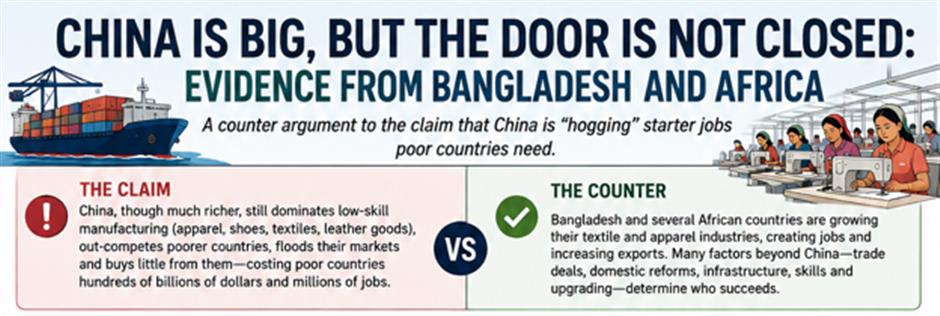
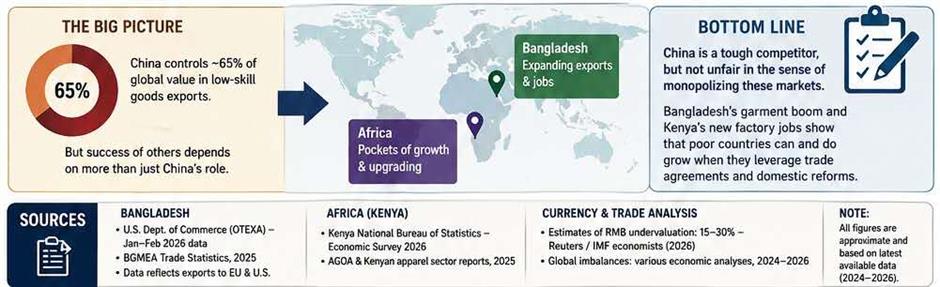
New research has revived an old anxiety: that China's dominance in low-skilled manufacturing like apparel, footwear, textiles and toys is closing the door on industrialization for poorer countries. The argument goes that China should have "graduated" by now, ceding the space to Bangladesh, Kenya and other low-income countries the way Japan and South Korea once did, and that its refusal to do so, reinforced by an undervalued currency, amounts to a kind of mercantilist squeeze on the developing world.
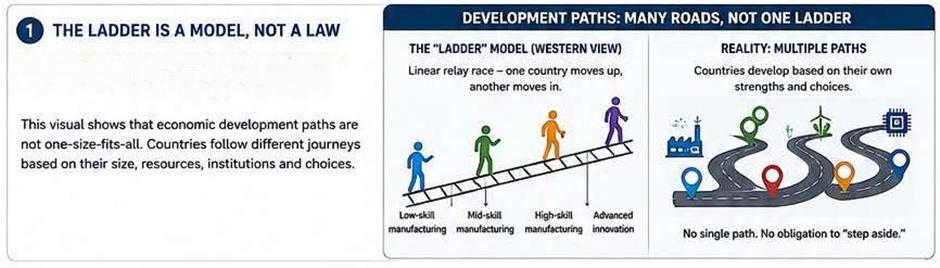
The narrative is difficult to find convincing. The so-called ladder metaphor is a Western economic model, not a law of nature.
The entire premise rests on a specific theory of development: that economies climb a ladder, with rich countries occupying the top rungs of high-value production while poorer countries take over the bottom rungs of basic manufacturing.
But why should this particular sequencing be treated as economic scripture? Every country has the right to pursue the development path that its resource base, labor force, capital markets and political system can sustain.
China did not sign a contract promising to vacate T-shirt factories once its per capita income crossed a certain threshold. Its economy is enormous, and the urge to treat it as though it should behave like a mid-sized European economy ignores the plain fact that scale changes the calculus.
A country like China cannot simply abandon labor-intensive production because doing so would strand tens of millions of its own workers. Insisting otherwise isn't economic analysis; it's imposing a template.
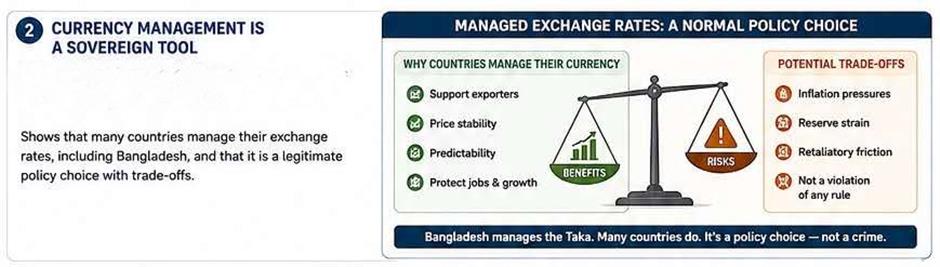
Currency management is a sovereign tool, not a scandal.
Much is also made of the yuan's managed exchange rate, as though this proves the game is rigged. The yuan is not yet a global transactional reserve currency the way the US dollar or euro is; if it were, it would float and settle on its own terms, and China's room to manage it would shrink considerably.
Currency management remains a legitimate instrument of domestic economic policy, not a violation of some universal rulebook. Bangladesh itself has long kept its currency exchange rate against the dollar under close central bank management rather than letting it float freely.
There is nothing inherently wrong with either approach. Each carries trade-offs, offering exporters price stability and predictability while risking inflation, reserve strain, and retaliatory friction with trading partners. The point is that managed currencies are a normal policy choice open to any sovereign nation, not a uniquely some sort of Chinese sin.
China is not walling off its know-how. It is actively exporting it. Bangladesh is a case in point of Chinese firms steadily deepening their industrial presence offshore.
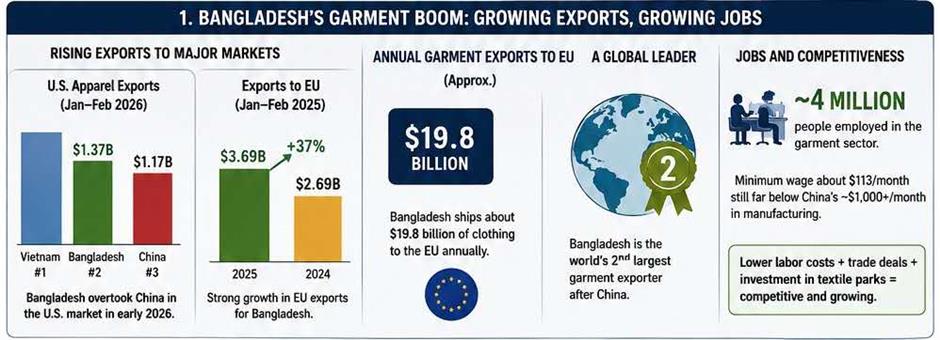
In June, 12 Chinese companies pledged over US$9 billion in prospective investment during a high-level visit to Beijing by Bangladesh's leadership, covering everything from electric smart-meter manufacturing and rail rolling stock to port logistics. The Bangladesh Garment Manufacturers and Exporters Association has been in direct talks with the Overseas Chinese Association in Bangladesh about joint ventures, factory acquisitions and machinery upgrades.
Bangladeshi officials have openly framed this as an opportunity. As China's wages rise and its industry moves toward advanced manufacturing, labor-intensive production is exactly what China has an incentive to relocate. Bangladesh has said clearly: It wants to absorb it.
This is not charity, and it shouldn't be mistaken for it. It is commerce, flowing toward wherever costs and conditions make it profitable.
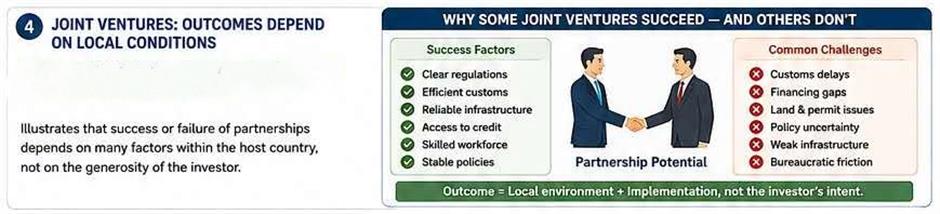
Joint ventures succeed or fail on their own merits. Some partnerships flourish; others will stall over customs delays, financing gaps or unclear land acquisition policies.
When a joint venture fails, that is not evidence that China is stingy with its technology. It is evidence that a specific deal didn't clear ordinary hurdles like regulatory friction, credit availability or the local business climate.
India's manufacturing partnerships with Japan, South Korea and others have had mixed results: Some succeeded, some didn't. No one claimed Japan owed India an auto industry. The variable that determined outcomes was not the generosity of the investing country; it was the receiving country's own policy environment, institutional readiness and capacity to absorb the investment productively.
The obligation runs the other way – becoming competitive should be the priority.It is not China's duty to voluntarily surrender competitive industries so that others can inherit them. No country has ever developed by waiting for a rival to step aside. If Bangladesh, or Kenya, or Vietnam wants to compete with China, or with each other, the responsibility sits with them to reform trade and customs policies, to build reliable power and port infrastructure, to train a workforce and to make their regulatory environments predictable enough to attract capital.
Business seeks returns. It does not follow moral argument. Treating market share as something one country is obligated to concede to another misunderstands what competitiveness is all about.
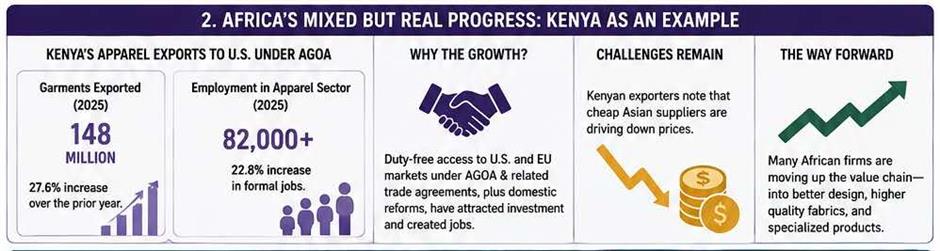
None of this is to dismiss the real difficulties poorer countries face, including price pressure from efficient, heavily scaled Chinese exporters. But an honest diagnosis matters. Kenyan apparel exporters have expanded rapidly due to improved market access and increased investment, rather than because China retreated, demonstrating that growth is achievable for countries that create the right enabling conditions.Keeping people working is not a consolation prize, it's the whole point.
There is a deeper logic to why countries with large, young populations and modest currencies should not be in a hurry to abandon basic manufacturing.
Labor-intensive industry, by definition, absorbs the most workers per dollar of output. For a country with a large population and comparatively limited capital, shifting prematurely toward capital-intensive, high-skill sectors and less labor per unit of output is not a mark of sophistication. Rather, it's likely a mismatch between strategy and endowment. It leaves large numbers of working-age people without productive employment, which is economically and socially corrosive.
Supporting Bangladesh and African growth is wise, but success comes from making themselves attractive to investors, not asking China to step back. Every industrialized economy has faced this test, which is always tough. Japan didn't wait for permission. It invested in infrastructure and competed. South Korea did the same.
China itself, in the story its critics tell, clawed its way up from the bottom of global manufacturing through decades of policy discipline, infrastructure investment and a willingness to specialize in low-margin work long after it was fashionable to do so.
There is no reason the next generation of manufacturing powers should expect an easier path handed to them, or feel entitled to one. The pledges of Chinese capital now flowing toward Bangladesh's ports, power grids and garment machinery are an opening, not an entitlement, and openings are only worth as much as a country's capacity to seize them.